What: Workshop on ‘Intellectual property Right awarness, acquisition and commercialization’ arranged by MCCIA on the occasion of World Intellectual Property Day When: 3pm, Friday, 24 April Where: Hall no. 6, 5th Floor, Wing A, MCCIA Trade Tower, S.B. Road Registration and Fees: This event is free for all to attend. No registration required.
Details:
On the occasion of World Intellectual Property Day, MCCIA is organizing a workshop on ‘Intellectual property Right awarness, acquisition and commercialization”. The workshop aims to provide an interface between the Industry and IP professionals so that the participants can leverage IP as a better business tool in their Corporate Wealth Creation. The topics of discussion will include cost effective way to protect IP, IP as a successful business tool, licensing stratergies, IP valuation doring public issues, IPR policy acquisition, invention disclosure etc.
The three hour workshop will commence at 3pm on Friday, April 24 at Hall No. 6, 5th Floor, A Wing, MCCIA, Senapati Bapat Road, Pune 16. There will be no participation fees for this workshop.
For more information about other tech events happening in Pune, see the PuneTech Calendar.
What: An overview of the features of Java Persistence 2.0 with JBoss/Hibernate Guru Emmanuel Bernard When: Wednesday, 22st April, 4:30pm Where: Red Hat Pune 6th Floor, East Wing Marisoft-III, Marigold Premises, Kalyani Nagar, Pune Registration and Fees: This event is free for all to attend. No registration required
Details:
This will be the second presentation by Emmanuel Bernard, who is visiting Pune currently. The first presentation on “Hibernate Search” will be on Tuesday, 21st April. This one is at the same time, same place, but on Wednesday.
Java Persistence has standardized Object Relational mapping in Java and Java EE and has been hugely adopted. This presentation will introduce you to the new features of Java Persistence 2.0 as most requested by the community and specified by the expert group. These include the new Criteria API, support for collections of simple type and Map support as well as support for Bean Validation.
What: A deep dive into Hibernate Search with JBoss/Hibernate Guru Emmanuel Bernard When: Tuesday, 21st April, 4:30pm Where: Red Hat Pune 6th Floor, East Wing Marisoft-III, Marigold Premises, Kalyani Nagar, Pune Registration and Fees: This event is free for all to attend. No registration required
Details:
As we had reported last week, Emmanuel Bernard, JBoss and Hibernate guru, the founder and co-founder of all annotation related projects in Hibernate, is in Pune and the Pune JBoss Users Group has arranged two lectures by Emmanuel for the benefit of the Java community in Pune.
The first of these lectures is on Tuesday, 21st April, and the second is on Wednesday 22nd April. Details of the second talk will be covered in a separate post.
Abstract: Adding search “like Google” to your Java applications
How many times has a customer told you they want to search in their application “like Google“? How many times was the search engine in your application too slow? Hibernate Search brings full-text search
capabilities to a persistent domain model, providing Google-like search capabilities while avoiding the traditional cost and difficulties to set up such solutions.
In this session, you will learn what problems Hibernate Search can solve and you will follow the steps of adding it to a Hibernate based application. You will build your own application specific full-text search engine. We will also explore advance subjects such as clustering and the underlyings of phonetic approximation.
To connect with others in Pune interested in JBoss, Hibernate and relatives, join the Pune JBoss Users Group.
What: POCC meeting on “Branding your IP: A mantra to global success” and “Hi-Technology Marketing” When: Saturday, 18th April (today!), 4pm Where: Symbiosis Institute of Computer Studies and Research, Atur Centre, Model Colony. Map. Registration and Fees: This event is free for all. No registration required
Branding your IP: Your mantra for global success – Prantik Mazumdar
Prantik Mazumdar, Consultant and Country Manager for StrategiCom, has kindly agreed to take a branding session. StrategiCom mainly deals for brand evaluation and positioning for SME’s around the globe.
He shall be accompanied by Prof Kaustubh, Associate Prof and Faculty for Corporate Training at SIBM, Lavale. The 2 together operate the free weekly brand health clinic at SIBM for SME’s
Abstract of the talk
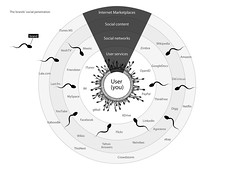
Social penetration of your brand. Image by activeside via Flickr
They say “Necessity is the mother of all inventions” and it is some of these inventions that empower and transform our world. Some of the grandest inventions that have had a significant impact on our lives today include the wheel, electricity, the light bulb, the automobile, telephones, mobile phones, the internet, etc. But was just inventing these ideas, concepts and processes enough for them to succeed and transform our world?
Just google “why startups fail” and there would be a host of sites proclaiming that about 9 out of 10 startups fail within the first two to three years of business! Is there something that can help increase and insure your chances of success? Something that can ensure and protect your growth? – The answer lies in commercializing, protecting and most importantly branding your intellectual property right from day one!
The session would focus on 7 key steps that entrepreneurs must take to build strong brands out of their inventions and innovations
Hi-Technology Marketing – Abhijit Athavale
Abhijit Athavale shall be talking on identity, positioning, sementation and market analysis, value proposition, messaging, campaigning and measurement.
See the PuneTech calendar for information about other tech events happening in this weekend.
(PuneTech is honored to have Dr. Narayan Venkatasubramanyan, an Optimization Guru and one of the original pioneers in applying Optimization to Supply Chain Management, as our contributor. I had the privilege of working closely with Narayan at i2 Technologies in Dallas for nearly 10 years.
For Dr. Narayan Venkatasubramanyan’s detailed bio, please click here.
This is the first in a series of articles that we will publish once a week for a month. For the full series of articles, click here.)
the following entry was prompted by a request for an article on the topic of “optimization” for publication in punetech.com, a website co-founded by amit paranjape, a friend and former colleague. for reasons that may have something to do with the fact that i’ve made a living for a couple of decades as a practitioner of that dark art known as optimization, he felt that i was best qualified to write about the subject for an audience that was technically savvy but not necessarily aware of the application of optimization. it took me a while to overcome my initial reluctance: is there really an audience for this after all, even my daughter feigns disgust every time i bring up the topic of what i do. after some thought, i accepted the challenge as long as i could take a slightly unusual approach to a “technical” topic: i decided to personalize it by rooting in a personal-professional experience. i could then branch off into a variety of different aspects of that experience, some technical, some not so much. read on …
background
the year was 1985. i was fresh out of school, entering the “real” world for the first time. with a bachelors in engineering from IIT-Bombay and a graduate degree in business from IIM-Ahmedabad, and little else, i was primed for success. or disaster. and i was too naive to tell the difference.
for those too young to remember those days, 1985 was early in rajiv gandhi‘s term as prime minister of india. he had come in with an obama-esque message of change. and change meant modernization (he was the first indian politician with a computer terminal situated quite prominently in his office). for a brief while, we believed that india had turned the corner, that the public sector companies in india would reclaim the “commanding heights” of the economy and exercise their power to make india a better place.
CMC was a public sector company that had inherited much of the computer maintenance business in india after IBM was tossed out in 1977. quickly, they broadened well beyond computer maintenance into all things related to computers. that year, they recruited heavily in IIM-A. i was one of an unusually large number of graduates who saw CMC as a good bet.
not too long into my tenure at at CMC, i was invited to meet with an mid-level manager in electronics & telecommunications department of the oil and natural gas commission of india (ONGC). the challenge he posed us was simple: save money by optimizing the utilization of helicopters in the bombay high oilfield.
the problem
the bombay high offshore oilfield, the setting of our story
the bombay high oilfield is about 100 miles off the coast of bombay (see map). back then, it was a collection of about 50 oil platforms, divided roughly into two groups, bombay high north and bombay high south.
(on a completely unrelated tangent: while writing this piece, i wandered off into searching for pictures of bombay high. i stumbled upon the work of captain nandu chitnis, ex-navy now ONGC, biker, amateur photographer … who i suspect is a pune native. click here for a few of his pictures that capture the outlandish beauty of an offshore oil field.)
movement of personnel between platforms in each of these groups was managed by a radio operator who was centrally located.
all but three of these platforms were unmanned. this meant that the people who worked on these platforms had to be flown out from the manned platforms every morning and brought back to their base platforms at the end of the day.
at dawn every morning, two helicopters, flew out from the airbase in juhu, in northwestern bombay. meanwhile, the radio operator in each field would get a set of requirements of the form “move m men from platform x to platform y”. these requirements could be qualified by time windows (e.g., need to reach y by 9am, or not available for pick-up until 8:30am) or priority (e.g., as soon as possible). each chopper would arrive at one of the central platforms and gets its instructions for the morning sortie from the radio operator. after doing its rounds for the morning, it would return to the main platform. at lunchtime, it would fly lunchboxes to the crews working at unmanned platforms. for the final sortie of the day, the radio operator would send instructions that would ensure that all the crews are returned safely to their home platforms before the chopper was released to return to bombay for the night.
the challenge for us was to build a computer system that would optimize the use of the helicopter. the requirements were ad hoc, i.e., there was no daily pattern to the movement of men within the field, so the problem was different every day. it was believed that the routes charted by the radio operator were inefficient. given the amount of fuel used in these operations, an improvement of 5% over what they did was sufficient to result in a payback period of 4-6 months for our project.
this was my first exposure to the real world of optimization. a colleague of mine — another IIM-A graduate and i — threw ourselves at this problem. later, we were joined yet another guy, an immensely bright guy who could make the lowly IBM PC-XT — remember, this was the state-of-the-art at that time — do unimaginable things. i couldn’t have asked to be a member of a team that was better suited to this job.
the solution
we collected all the static data that we thought we would need. we got the latitude and longitude of the on-shore base and of each platform (degrees, minutes, and seconds) and computed the distance between every pair of points on our map (i think we even briefly flirted with the idea of correcting for the curvature of the earth but decided against it, perhaps one of the few wise moves we made). we got the capacity (number of seats) and cruising speed of each of the helicopters.
we collected a lot of sample data of actual requirements and the routes that were flown.
we debated the mathematical formulation of the problem at length. we quickly realized that this was far harder than the classical “traveling salesman problem”. in that problem, you are given a set of points on a map and asked to find the shortest tour that starts at any city and touches every other city exactly once before returning to the starting point. in our problem, the “salesman” would pick and/or drop off passengers at each stop. the number he could pick up was constrained, so this meant that he could be forced to visit a city more than once. the TSP is known to be a “hard” problem, i.e., the time it takes to solve it grows very rapidly as you increase the number of cities in the problem. nevertheless, we forged ahead. i’m not sure if we actually completed the formulation of an integer programming problem but, even before we did, we came to the conclusion that this was too hard of a problem to be solved as an integer program on a first-generation desktop computer.
instead, we designed and implemented a search algorithm that would apply some rules to quickly generate good routes and then proceed to search for better routes. we no longer had a guarantee of optimality but we figured we were smart enough to direct our search well and make it quick. we tested our algorithm against the test cases we’d selected and discovered that we were beating the radio operators quite handily.
then came the moment we’d been waiting for: we finally met the radio operators.
they looked at the routes our program was generating. and then came the first complaint. “your routes are not accounting for refueling!”, they said. no one had told us that the sorties were long enough that you could run out of fuel halfway, so we had not been monitoring that at all!
ONGC’s HAL Dhruv Helicopters on sorties off the Mumbai coast. Image by Premshree Pillai via Flickr
so we went back to the drawing board. we now added a new dimension to the search algorithm: it had to keep track of fuel and, if it was running low on fuel during the sortie, direct the chopper to one of the few fuel bases. this meant that some of the routes that we had generated in the first attempt were no longer feasible. we weren’t beating the radio operators quite as easily as before.
we went back to the users. they took another look at our routes. and then came their next complaint: “you’ve got more than 7 people on board after refueling!”, they said. “but it’s a 12-seater!”, we argued. it turns out they had a point: these choppers had a large fuel tank, so once they topped up the tank — as they always do when they stop to refuel — they were too heavy to take a full complement of passengers. this meant that the capacity of the chopper was two-dimensional: seats and weight. on a full tank, weight was the binding constraint. as the fuel burned off, the weight constraint eased; beyond a certain point, the number of seats became the binding constraint.
we trooped back to the drawing board. “we can do this!”, we said to ourselves. and we did. remember, we were young and smart. and too stupid to see where all this was going.
in our next iteration, the computer-generated routes were coming closer and closer to the user-generated ones. mind you, we were still beating them on an average but our payback period was slowly growing.
we went back to the users with our latest and greatest solution. they looked at it. and they asked: “which way is the wind blowing?” by then, we knew not to ask “why do you care?” it turns out that helicopters always land and take-off into the wind. for instance, if the chopper was flying from x to y and the wind was blowing from y to x, the setting was perfect. the chopper would take off from x in the direction of y and make a bee-line for y. on the other hand, if the wind was also blowing from x to y, it would take off in a direction away from y, do a 180-degree turn, fly toward and past y, do yet another 180-degree turn, and land. given that, it made sense to keep the chopper generally flying a long string of short hops into the wind. when it could go no further because they fuel was running low or it needed to go no further in that direction because there were no passengers on board headed that way, then and only then, did it make sense to turn around and make a long hop back.
“bloody asymmetric distance matrix!”, we mumbled to ourselves. by then, we were beaten and bloodied but unbowed. we were determined to optimize these chopper routes, come hell or high water!
so back we went to our desks. we modified the search algorithm yet another time. by now, the code had grown so long that our program broke the limits of the editor in turbo pascal. but we soldiered on. finally, we had all of our users’ requirements coded into the algorithm.
or so we thought. we weren’t in the least bit surprised when, after looking at our latest output, they asked “was this in summer?”. we had now grown accustomed to this. they explained to us that the maximum payload of a chopper is a function of ambient temperature. on the hottest days of summer, choppers have to fly light. on a full tank, a 12-seater may now only accommodate 6 passengers. we were ready to give up. but not yet. back we went to our drawing board. and we went to the field one last time.
in some cases, we found that the radio operators were doing better than the computer. in some cases, we beat them. i can’t say no creative accounting was involved but we did manage to eke out a few percentage point of improvement over the manually generated routes.
epilogue
you’d think we’d won this battle of attrition. we’d shown that we could accommodate all of their requirements. we’d proved that we could do better than the radio operators. we’d taken our machine to the radio operators cabin on the platform and installed it there.
we didn’t realize that the final chapter hadn’t been written. a few weeks after we’d declared success, i got a call from ONGC. apparently, the system wasn’t working. no details were provided.
i flew out to the platform. i sat with the radio operator as he grudgingly input the requirements into the computer. he read off the output from the screen and proceeded with this job. after the morning sortie was done, i retired to the lounge, glad that my work was done.
a little before lunchtime, i got a call from the radio operator. “the system isn’t working!”, he said. i went back to his cabin. and discovered that he was right. it is not that our code had crashed. the system wouldn’t boot. when you turned on the machine, all you got was a lone blinking cursor on the top left corner of the screen. apparently, there was some kind of catastrophic hardware failure. in a moment of uncommon inspiration, i decided to open the box. i fiddled around with the cards and connectors, closed the box, and fired it up again. and it worked!
it turned out that the radio operator’s cabin was sitting right atop the industrial-strength laundry room of the platform. every time they turned on the laundry, everything in the radio room would vibrate. there was a pretty good chance that our PC would regress to a comatose state every time they did the laundry. i then realized that this was a hopeless situation. can i really blame a user for rejecting a system that was prone to frequent and total failures?
other articles in this series
this blog entry is intended to set the stage for a series of short explorations related to the application of optimization. i’d like to share what i’ve learned over a career spent largely in the business of applying optimization to real-world problems. interestingly, there is a lot more to practical optimization than models and algorithms. each of the the links below leads to a piece that dwells on one particular aspect.
Dr. Narayan Venkatasubramanyan has spent over two decades applying a rare combination of quantitative skills, business knowledge, and the ability to think from first principles to real world business problems. He currently consults in several areas including supply chain and health care management. As a Fellow at i2 Technologies, he tackled supply chains problems in areas as diverse as computer assembly, semiconductor manufacturer, consumer goods, steel, and automotive. Prior to that, he worked with several airlines on their aircraft and crew scheduling problems. He topped off his days at IIT-Bombay and IIM-Ahmedabad with a Ph.D. in Operations Research from the University of Wisconsin-Madison.
He is presently based in Dallas, USA and travels extensively all over the world during the course of his consulting assignments. You can also find Narayan on Linkedin at: http://www.linkedin.com/in/narayan3rdeye
What: This is the first meeting of the Pune Tivoli Users Group – with introductory presentations on various Tivoli products When: 9:30am to 1:30pm, Saturday 18th April Where: Meeting Room M4 (Video Conference Room), 7th Floor, Tower (B), Tech Park One (TPO), (Panchshill), Off Airport Road, Near Don Bosco School, Yerwada Registration and Fees: This meeting is free for all to attend. Register here.
Details:
Come along to the first ever Pune Tivoli User Group meeting and meet like minded people. Your presence will help to make this group a success !
Agenda:
9:30am – Introduction for Tivoli User Group members. What do YOU want to get out of YOUR group
Topic #1 – TSM FastBack : Introduction & Architecture
Speaker: Chanchal Ghevade, IBM
Topic #2 – Introduction to Tivoli Identity and Access Management
Speaker: Deepak Kaul, IBM
Topic #3 – Introduction to Tivoli Storage Manager
Speaker: Rahul Sharma, IBM
Topic #4 – Introduction to IBM Tivoli Monitoring
Speaker: Himanshu Karmarkar, IBM
Topic #5 – IBM Support Assistant (ISA) tool for Tivoli products
Feedback & close
Lunch and networking.
As usual, see the PuneTech calendar for other tech events in Pune this week.
Stay tuned for details of the event that the PuneJBUG is planning. If you want to meet Emmanuel separately, you can try to get in touch with Jaikiran, the creator/moderator of PuneJBUG, or you can directly message Emmanuel via twitter.
This is a community for JBoss developers in Pune (or any other part of India). The group will soon be starting regular events related to JBoss community projects. Feel free to suggest an event that you would like to organize or participate with other JBoss community users. Mailing List: http://groups.google.com/group/jbug-pune
About Emmanuel Bernard
Emmanuel is a Lead developer at JBoss, a division of Red Hat. After graduating from Supelec (French “Grande Ecole”), Emmanuel has spent a few years in the retail industry where he started to be involved in the ORM space. He joined the Hibernate team 4 years ago. Emmanuel is the lead developer of Hibernate Annotations and Hibernate EntityManager, two key projects on top of Hibernate core implementing the Java Persistence(tm) specification, as well as Hibernate Search and Validator. Emmanuel is a member of the EJB 3.0 expert group and the spec lead of JSR 303: Bean Validation. He is a regular speaker at various conferences and JUGs, including JavaOne, JBoss World and JavaPolis and the co-author of Hibernate Search in Action from Manning.
Rohit Ghatol, who was supposed to give the “Getting started with OpenSocial” presentation tomorrow is down with viral fever, and hence this event is postponed to next Saturday, 18th April. Other details remain the same. See the updated post for other details.
Sorry for the inconvenience caused.
– Vishwesh Jigrale, Pune GTUG Manager
Update: This event was earlier scheduled for 11 April. Rohit Ghatol, the presenter is down with viral fever, hence this event is postponed to 18th April What:Pune Google Technology Users Group (Pune GTUG) presents a seminar “Getting started with OpenSocial” When: Saturday, 18th April. 3pm onwards Where: Synerzip. Dnyanvatsal Commercial Complex, Survey No. 23, Plot No. 189, Near Mirch Masala Restaurant , Opp Vandevi Temple, Karve Nagar (Map). Registration and Fees: The event is free for all, no registration required. Details
Agenda for this meet is as follows
1. General overview of OpenSocial (But participates are expected to read about OpenSocial)
2. Getting started with a simple Gadget
3. Getting started with a simple OpenSocial Application
4. Overview of RestFul APIs for Server side OpenSocial Applications
What: Monthly meeting of Project Management Institute’s Deccan Pune Chapter, featuring an introduction to the Telecom Software Domain, and an introduction to Six Sigma When: Saturday, 11 April, 10am to 12:30pm Where: Pune Shramik Patrakar Sangh, Cummins Auditorium, 193 Navi Peth, Ganjwe Chowk, Near Alka Talkies, Garware bridge Registration and Fees: This talk is free for all to attend. No registration required
Session 1: Telecom Domain Overview by Utkarsh Kikani
The session is based on understanding and knowledge that was developed from a vantage point of a software team member of an IT team of a typical Telco enterprise. It is meant to be an overview and introduction to Telecom as a domain or vertical. Telecom by its very nature can become quite a technological or technical subject. However, the current session is approached more from business angle. There will be a bit of technical Talk but that will be kept minimum and only when absolutely essential. A person who is barely familiar with the world of Telecom would have, at the end of an hour, developed a very high level understanding of the domain with some insights in to its evolution, current status and future trends.
Session 1: About the Speaker Utkarsh Kikani
Utkarsh Kikani MCA from Surat, started his career as a C++ programmer around 16 years ago. After first three years initial stint at a small start up in Gujarat moved to then Mahindra British Telecom which is now TechMahindra as Analyst Programmer. Utkarsh had 13 years long association with TechM with assignments with different Telcos – Singapore Telecom, British Telecom, U S West (now Qwest), Cingular Wireless, Rockwell First Point Contact and AT&T – in different roles of Team lead, Technical architect, Business Analyst, Onsite coordinator and Offshore Project manager and Program manager. Recently left TechM for a planned professional break, and currently teaching a course on Telecom Business Management to business management students as visiting faculty.
Session 2: Introduction to Six Sigma and Impact of Variation with Hemant Urdhwareshe
Six Sigma Approach is implemented by many reputed world class companies. These companies have been benefited immensely in terms of improving their bottom-line, customer satisfaction and waste reduction. The purpose of this presentation is to create awareness about the approach and opportunities. The presentation also includes a simulation of typical manufacturing processes to appreciate impact of variation in various processes on productivity and waste. The simulation also helps understand a strong linkage between Lean and Six Sigma. The presentation will also attempt to illustrate impact of variation in the context of project management
Session 2: About the Speaker Hemant P. Urdhwareshe
Hemant Urdhwareshe is a mechanical engineer from VNIT, Nagpur with post graduate diploma in business management from IMDR, Pune. Hemant director of Institute of Quality & Reliability, comes with a rich experience of 28+ years in Cummins India Limited (CIL). He worked as Sr. General Manager Product Engineering. Hemant is a Master Black Belt (MBB) and has trained more than 300 Black/Green Belts. He has conducted Six Sigma Black Belt/Green Belt programs for several companies along with implementation support and project reviews as MBB. Hemant has also conducted Design for Six Sigma Green Belt Program for Satyam Computers. He has conducted many other workshops in Reliability Basics, Design FMEA, Quality Function Deployment, and Reliability Growth covering more than 500+ participants. Hemant was one of the eminent panelists for Lean Six Sigma Excellence Awards organized by SCMHRD and Sakal. He has published series of articles on Six sigma & related topics in renowned journals & magazines. Recipient of several awards, Hemant is a member of several institutes like American Society for Quality (ASQ) etc.
 What: Workshop on ‘Intellectual property Right awarness, acquisition and commercialization’ arranged by MCCIA on the occasion of World Intellectual Property Day
![Reblog this post [with Zemanta]](http://img.zemanta.com/reblog_b.png?x-id=862a71ca-7600-4298-970f-f7a5c149fbee)

![Reblog this post [with Zemanta]](http://img.zemanta.com/reblog_b.png?x-id=22125db3-9932-4af5-a5b9-a533e76c1ee9)

![Reblog this post [with Zemanta]](http://img.zemanta.com/reblog_b.png?x-id=20f62a47-2591-405c-983b-65537d0f504d)



![Reblog this post [with Zemanta]](http://img.zemanta.com/reblog_b.png?x-id=4b7c32a0-1264-42f1-b98c-8f7fadffb135)

![Reblog this post [with Zemanta]](http://img.zemanta.com/reblog_b.png?x-id=6aeac31b-f7a4-4c24-8667-beed5c4d313b)
![Reblog this post [with Zemanta]](http://img.zemanta.com/reblog_b.png?x-id=e6dbe910-39b7-4bb2-b99a-adafe2acd6ba)

![Reblog this post [with Zemanta]](http://img.zemanta.com/reblog_b.png?x-id=d31e575b-7881-4174-8340-ba3ef1d9e9d1)
 What: Monthly meeting of

![Reblog this post [with Zemanta]](http://img.zemanta.com/reblog_b.png?x-id=17bd35d7-da70-4c7f-a2dd-1374bceca2b5)